How do you invest in crypto as a complete beginner in 2026?
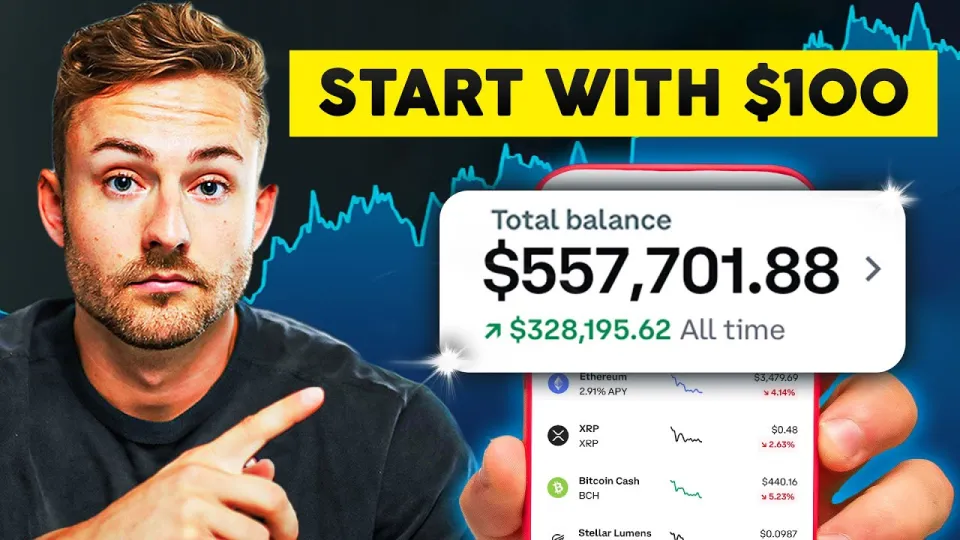
Video: How To Invest in Crypto as A COMPLETE Beginner [2025 GUIDE]
You can order the same kind of articles for your own video to boost it on YouTube and Google. Just message the Telegram bot @sat_sit_bot. Articles with your video embedded are written and posted by the bot itself — on popular topical sites (no ads). Your first 50 articles are free.
· based on the channel Craig Percoco
Key takeaways
- Craig Percoco draws on seven years of trading and investing experience in his beginner guide to crypto.
- The guide is split into basics, upside potential, fundamentals, technicals, income strategies, buying and selling, and organization.
- Crypto newcomers typically fail for seven recurring reasons: no system, no patience, no discipline, no backtesting, no journaling, poor psychology and poor risk management.
- Futures and crypto trading are high risk, losses can exceed the initial investment, and only risk capital should be used.
- Affiliate links in the video generate commissions for the creator, and the content is presented as entertainment rather than financial advice.
Crypto investing for a complete beginner starts with three steps: learn what a blockchain and a token actually are, decide how much risk capital you can afford to lose, and buy a small position in Bitcoin or Ethereum through a regulated exchange before touching anything more exotic. Craig Percoco, who has spent seven years trading and investing, structures his beginner guide around exactly this progression — basics first, then fundamentals, then technicals, and only after that the question of how money is actually made. You can start with the free trading education he links in the video: free trading training resources.
What a complete beginner needs to know about crypto basics
A cryptocurrency is a digital asset recorded on a blockchain, a distributed ledger that no single party controls. Bitcoin, launched in 2009, was the first; Ethereum followed in 2015 and added programmable smart contracts. Everything else — thousands of tokens — is an altcoin, and most of them will not survive a full market cycle.
The practical basics are less about technology and more about mechanics. You need a wallet or an exchange account, you need to understand that transactions are irreversible, and you need to accept that prices can move 10% in a day in either direction. Crypto trades 24 hours a day, seven days a week, with no circuit breakers and no closing bell. That is the environment a beginner is stepping into.
Three concepts do most of the work in early decisions:
- Market cap, not price. A token trading at $0.0001 is not cheaper than one at $60,000 — what matters is total supply multiplied by price.
- Liquidity. Thin order books mean large orders move the price against you, and exits get expensive in a panic.
- Custody. Coins on an exchange are coins you do not control; a hardware wallet puts the private keys in your hands.
Why the upside potential attracts investors and what it costs
Crypto is a young, fast-moving market where entire sectors — decentralized finance, layer-2 scaling, tokenized real-world assets — have gone from zero to tens of billions of dollars in value within a few years. That is the case for allocating a slice of a portfolio to it: asymmetric upside from an asset class that is still small relative to equities or gold.
The cost of that upside is volatility and the absence of investor protection. There is no FDIC-style insurance on a crypto exchange balance, no one to call when a token collapses, and no refund for a fat-fingered transfer to the wrong address. Projects fail, exchanges have frozen withdrawals, and tokens have gone to near zero after a single exploit. The correct mental model is venture capital, not savings: a small allocation you can lose entirely without changing your life.
Crypto fundamentals: how to judge a project before buying
Fundamentals in crypto means asking who is building the thing, who is paying for it, and who gets the tokens. The single most important document is the tokenomics: total supply, circulating supply, vesting schedules and unlock dates. A project with 20% of supply circulating and a large unlock three months out has a structural headwind that no chart pattern will fix.
A workable checklist for evaluating a token:
- Team and track record. Named, public developers with shipped code beat anonymous teams with a whitepaper.
- Real usage. Active addresses, fees paid, total value locked — numbers that can be checked on-chain rather than claimed on a website.
- Token utility. Does the token do something necessary in the network, or is it purely a governance sticker?
- Unlock schedule. Large insider unlocks are predictable sell pressure.
- Competition. If three better-funded teams do the same thing, the market cap should reflect that.
Fundamentals do not tell you when to buy. They tell you what deserves a place on your watchlist at all.
Crypto technicals: reading price without overcomplicating it
Technicals are the study of price and volume history to time entries and exits, and for a beginner they should stay simple. Support and resistance levels, trend structure (higher highs versus lower highs), and volume confirmation cover most of what a retail investor needs. Moving averages — the 50-day and 200-day in particular — give a rough sense of whether the market is in an uptrend or a downtrend.
Charting platforms such as TradingView, which the video lists among its tools, let you draw these levels for free. The discipline is not in the indicators but in the rules: define the entry, define the invalidation point, and size the position so that being wrong costs a small, pre-agreed percentage of the account. Most beginners do the opposite — they enter on a feeling and exit on a feeling, with no level that would prove them wrong.
How money is actually made and lost in crypto
There are four broad ways to make money in crypto, and they carry very different risk profiles. Buying and holding a major asset over years is the slowest and most forgiving. Staking or lending earns yield on holdings but adds smart-contract and counterparty risk. Swing trading around major levels requires screen time and a written system. Leveraged futures trading offers the fastest gains and is where the overwhelming majority of beginners lose their capital.
The failure pattern is consistent and well documented by traders themselves: no system, no patience, no discipline, no backtesting, no journaling, poor psychology and poor risk management. Position sizing is the lever that matters most — risking 1–2% of the account per trade means a losing streak of ten trades costs roughly a tenth of the balance, not the whole thing. Chasing small wins with tiny capital and no process produces the same result as gambling: activity without edge.
How to buy and sell crypto step by step
- Choose a regulated exchange with a long operating history and proof-of-reserves disclosures.
- Complete identity verification — this is mandatory at any legitimate platform.
- Fund the account with a bank transfer or card, starting with an amount you are prepared to lose.
- Place a market order for a major asset, or a limit order if you want a specific price.
- Move long-term holdings to a hardware wallet and store the seed phrase offline, on paper or metal, never in a photo.
- When selling, decide in advance whether you are taking profit in stablecoins or back to fiat, and check the withdrawal fees before you click.
Fees compound: trading fees, spread, network fees and withdrawal fees all eat into a beginner's returns. Comparing them before the first trade is worth more than any indicator.
How to stay organized as a crypto investor
Organization is what separates investors from gamblers. Keep a spreadsheet or journal with every position: date, asset, entry price, size, the reason for the trade, the exit plan, and the outcome. Review it monthly. Track your cost basis for tax purposes from day one — retrofitting a year of transactions is painful.
Separate your accounts by purpose: a long-term holding wallet, a trading account with a fixed bankroll, and a small experimental bucket for high-risk plays. Set a maximum allocation to crypto as a percentage of net worth and rebalance when the market moves you past it. Boring, but it is the difference between surviving a bear market and being forced to sell at the bottom.
Common questions and doubts from new crypto investors
Skepticism is healthy and common. Many newcomers arrive unsure whether crypto is a real asset class at all, and the answer is to start small, verify claims on-chain, and let experience rather than hype set the size of the position. Doubt about one's own ability to trade is equally justified: the statistics on retail losses in leveraged products are brutal, which is why holding and learning come before active trading.
The most frequent practical doubts concern mentorship and paid courses. A structured curriculum shortens the learning curve, but no course removes risk, and claims of guaranteed returns or spectacular short-term profits should be treated as marketing. The reliable path is education plus small live positions plus a written record of every decision.
All resources mentioned in the guide
- Free trading education
- Crypto trading course and private team
- Discord community access
- All resources
- TradingView charting
The bottom line on starting in crypto
A complete beginner should treat crypto as a small, high-risk allocation inside a diversified financial life, not as a lottery ticket. Learn the basics, check tokenomics before charts, keep position sizes small enough to survive mistakes, and write down every decision. Craig Percoco's breakdown on his channel covers this full path from first purchase to portfolio organization, and the free training linked at the start is the natural first stop: start learning trading for free. Remember that futures and crypto trading are highly risky, losses can exceed the initial investment, and nothing here is financial advice.
Questions & answers
How much money do I need to start investing in crypto?
You can start with a very small amount, but the more useful question is what percentage of your net worth crypto should represent. Most cautious beginners allocate a single-digit percentage they can afford to lose entirely, then buy a major asset like Bitcoin or Ethereum first. Leverage and altcoins only make sense once that base position and a written plan exist.
Is it realistic to turn a small account into a large one by trading crypto?
Occasionally, yes, but the base rate is poor. Leveraged trading wipes out most retail accounts because of oversized positions, no stop rules and no journal. Traders who report large gains usually describe years of losses, backtesting and strict risk management before profitability, not a shortcut.
Do I need a mentor or a paid course to learn crypto trading?
Not strictly, but structure helps. Free resources and exchange documentation cover the mechanics, while a course or community can enforce discipline and speed up feedback. Be skeptical of anyone promising guaranteed returns or spectacular results in weeks, and never hand over funds to a stranger offering to trade for you.
How do I keep my crypto safe from hacks and mistakes?
Use a reputable exchange with proof-of-reserves, enable two-factor authentication with an app rather than SMS, and move long-term holdings to a hardware wallet. Store the seed phrase offline on paper or metal, never as a photo or cloud note, and always test a small transfer before sending a large amount to a new address.
Source: How To Invest in Crypto as A COMPLETE Beginner [2025 GUIDE] · Markdown version